 Alene Laney
Key Takeaways
- The national median utility cost for homeowners is $347 per month, and will likely increase over your time as a homeowner.
- The amount you pay for utilities is affected by the size and age of your home, how energy-efficient your home is, climate and geography, the number of occupants in the home, and your utility providers.
- Investing in energy-efficient upgrades can help save money on utilities every month.
- Home equity is a logical funding source since energy-efficient upgrades can increase home value.
No matter how prepared you are to be a homeowner, those first utility bills can be eye opening. Even if you’ve owned a home for a while, rising utility bills have likely left you with sticker shock. Residential electricity bills have increased by almost 40% over the last five years.
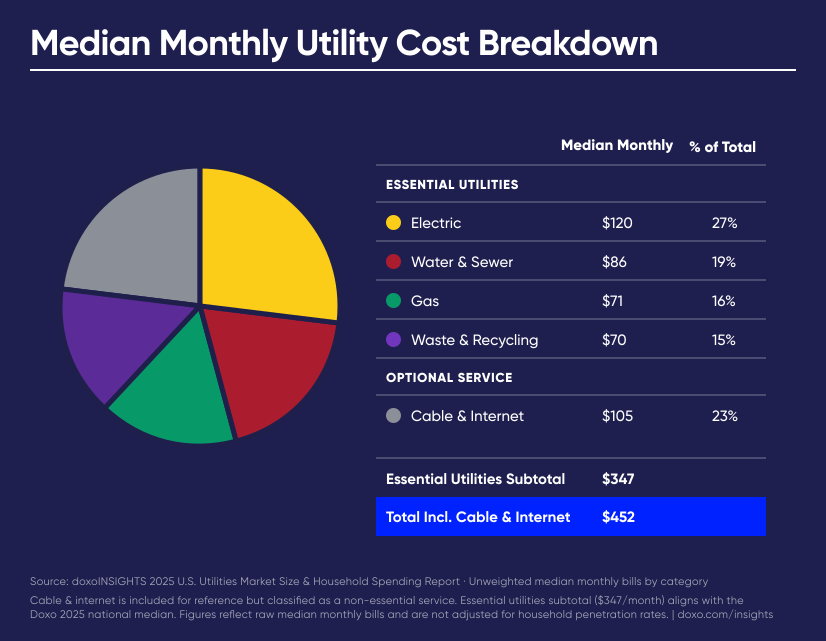
According to DoxoINSIGHTS 2025, the national median utility cost for homeowners is $347 per month – amounting to about 5% of total household income. That number will be different for every homeowner, and while there’s no avoiding paying utilities, there are some smart moves you can make to keep more money in your pocket.
This article is a comprehensive guide to utility costs for homeowners. We cover what drives the cost of utilities, what you can expect to pay, how to reduce utility costs, energy-efficient upgrades to make, and how to pay for them.
What Counts as a Utility?
What exactly counts as a utility? A utility is a service used by the public, such as electricity or gas.
The core utility types you’ll typically see include the following:
- Electricity: This is your power bill, and often your highest bill. Your power provider could be a city, a co-op, an investor-owned utility, a public utility district, a federal power utility, or a tribal utility.
- Water, sewer, and stormwater: Water is typically billed based on a combination of a fixed fee and usage. You may also see a charge for stormwater and sewer services.
- Gas: Many homes require gas for heating, cooking, hot water, and more. Gas is installed and typically paid separately from the other utilities.
- Waste and recycling: Rates are highly localized for waste and recycling. You may see municipalities own their waste and recycling utilities, while other cities use private companies for garbage collection and recycling. If you live in an HOA community, your HOA fees may include trash pickup.
When you’re renting, you likely only have to pay for a few of these. When you’re a homeowner, the responsibility is all yours.
Optional vs. essential services: Cable and internet
Though they may be required for everyday life, internet and cable are considered optional utilities. Cable and internet average $121 per month, according to Doxo.
What’s Included in the Average Utility Bill?
The chart below details what is typically included in the average utility bill. As you can see, electricity accounts for most of the monthly costs, followed by water and sewer and gas. While not considered essential, cable and internet also make up a large chunk and raise the median monthly total from $347 to $452.
While these averages offer some indication of what you could pay, there are also other factors at play that could influence your utility costs.
Key Factors That Drive Utility Costs
Your utility bill may not follow the national average, or even your neighbor’s, for that matter. Several factors that drive utility costs, including:
Utility rate structures: You may see different utility rate structures on your bill, especially when it comes to power. Power companies can charge more for usage during peak hours. You’ll also see higher fixed fees, which will apply even for customers who generate enough solar power to cover the needs of their home.
Home size and type: The size and type of home also play a large role in energy cost. For example, a townhome with neighbors on either side will likely have lower heating bills due to the additional insulating factor.
Home age and efficiency: Older homes tend to be less efficient and have higher utility bills. Along the same lines, homes built with energy efficiency in mind will likely see lower utility bills.
Climate and geography: Your climate and geography will affect how much your utility bills will be. If you live in a four-season state, you know you’ll have a higher heating bill in the winter and a higher cooling bill in the summer.
Number of occupants: More people in the home mean higher utilities. More showers, more TVs on in the evening, more laundry, more microwave popcorn — it all adds up.
Appliance age and efficiency ratings: Older and less efficient appliances can affect the cost of utilities. It may be more significant than you realize. You’ll see incentives from your power provider to upgrade to more energy-efficient appliances.
EV charging at home: If you have an electric vehicle that you charge at home, you’ll see a higher electric bill.
Average Utility Costs by State
Utility costs can vary widely by state. Geographically isolated states like Hawaii and Alaska often have high costs because they need to import fuel or have power systems that are not connected to mainland grids. How does your state stack up?
These are the average utility costs by state, and how they compare with the national median utility costs.
Generally speaking, states where the monthly cost is greater than $380 are above average. States where the median cost falls between $348 and $380 are considered moderate, and those states where bills are less than $348 are below average.
| Rank | State | Monthly Median Cost | Annual Cost | Compared With the Median |
| 1. | Maryland | $546 | $6,552 | +57% higher |
| 2. | Connecticut | $488 | $5,856 | +41% |
| 3. | Massachusetts | $481 | $5,772 | +39% |
| 4. | Washington | $466 | $5,592 | +34% |
| 5. | Hawaii | $447 | $5,364 | +29% |
| 6. | Alaska | $445 | $5,340 | +28% |
| 7. | Rhode Island | $438 | $5,256 | +26% |
| 8. | New Jersey | $435 | $5,220 | +25% |
| 9. | Maine | $430 | $5,160 | +24% |
| 10. | Vermont | $425 | $5,100 | +22% |
| 11. | New Hampshire | $422 | $5,064 | +22% |
| 12. | Delaware | $421 | $5,052 | +21% |
| 13. | New York | $409 | $4,908 | +18% |
| 14. | Wisconsin | $407 | $4,884 | +17% |
| 15. | Nebraska | $400 | $4,800 | +15% |
| 16. | California | $390 | $4,680 | +12% |
| 17. | Alabama | $378 | $4,536 | +9% |
| 18. | Minnesota | $378 | $4,536 | +9% |
| 19. | Virginia | $371 | $4,452 | +7% |
| 20. | North Dakota | $369 | $4,428 | +6% |
| 21. | Pennsylvania | $367 | $4,404 | +6% |
| 22. | Michigan | $365 | $4,380 | +5% |
| 23. | Georgia | $363 | $4,356 | +5% |
| 24. | North Carolina | $360 | $4,320 | +4% |
| 25. | Texas | $356 | $4,272 | +3% |
| 26. | Iowa | $354 | $4,248 | +2% |
| 27. | Wyoming | $354 | $4,248 | +2% |
| 28. | Colorado | $348 | $4,176 | 0% (median) |
| 29. | Oregon | $341 | $4,092 | -2% (lower) |
| 30. | Florida | $340 | $4,080 | -2% |
| 31. | Missouri | $331 | $3,972 | -5% |
| 32. | Nevada | $329 | $3,948 | -5% |
| 33. | Indiana | $328 | $3,936 | -5% |
| 34. | Ohio | $325 | $3,900 | -6% |
| 35. | Illinois | $318 | $3,816 | -8% |
| 36. | Arizona | $317 | $3,804 | -9% |
| 37. | Kansas | $317 | $3,804 | -9% |
| 38. | South Carolina | $316 | $3,792 | -9% |
| 39. | Kentucky | $313 | $3,756 | -10% |
| 40. | Louisiana | $311 | $3,732 | -10% |
| 41. | Utah | $306 | $3,672 | -12% |
| 42. | Tennessee | $304 | $3,648 | -12% |
| 43. | Idaho | $302 | $3,624 | -13% |
| 44. | Oklahoma | $302 | $3,624 | -13% |
| 45. | Montana | $301 | $3,612 | -13% |
| 46. | Mississippi | $296 | $3,552 | -15% |
| 47. | West Virginia | $295 | $3,540 | -15% |
| 48. | Arkansas | $288 | $3,456 | -17% |
| 49. | New Mexico | $288 | $3,456 | -17% |
| 50. | South Dakota | $280 | $3,360 | 19% |
Source: doxoINISIGHTS 2025 Utility Reports
Seasonal Utility Cost Planning
Different seasons bring bigger bills in many parts of the U.S. You may see the following:
Summer
- Higher electricity costs from cooling
- Higher water bills from landscape irrigation
Winter
- Higher heating costs
- Higher costs from water heater
Spring & Fall
In states with four seasons, shoulder seasons may be less expensive based on your usage. There’s less need to heat or cool your home and irrigate your lawn.
Levelized and budget billing
While your utilities can vary by season, a levelized billing or budget billing program can make your monthly bill more consistent.
In these types of programs, you opt to pay approximately the same amount each month. With levelized billing, the amount you pay is a rolling average of the customer’s energy usage over the past 12 months. With budget billing, you opt to pay the same amount each month based on an average of the past year. It’s a slightly different calculation, and you’ll need to settle the difference in month 12.
How to Research Utility Costs Before Buying a Home
If you’re in the process of buying a home, there are a few ways to research utility costs.
- Ask the seller for 12 months of bills. The seller may be the best source of information when it comes to utility costs, so it’s helpful to ask here first.
- Contact local utility providers for address-level data. You may[1] be able to ask for information on utility costs for a home you have a contract on. Since the laws vary from state to state, you may run into a dead end, but you may be able to get the data by providing proof of ownership or consent from the current customer.
- Check EPA Home Energy Yardstick. You can get an estimate from the EPA based on the zip code, square footage, number of occupants, and the sources of fuels used. The yardstick can also compare the usage of your home with other similar homes in the same area.
It’s a smart move to factor in the cost of utilities as part of your total monthly housing budget. Knowing approximately how much your utilities will cost can help you understand the true cost of homeownership.
How to Lower Your Utility Bills
It is possible to lower your utility bills, both by changing habits and by making long-term investments in your home’s energy efficiency. Ideas for lowering your utility bills are included below.
No-cost behavior changes:
- Program your thermostat: If you have a programmable thermostat, set your temperatures lower while you’re away and adjust settings seasonally.
- Save water outside: You can save water outside by adjusting your watering schedule, watering in the morning, installing a drip system, using mulch to retain moisture, turning water off when it’s hot or windy, checking for leaks, or programming a smart irrigation controller.
- Run full loads: Wait until the dishwasher and laundry are full to run a load. Wash clothes in cold water when it makes sense.
- Reduce power usage. Turn off lights and electronics when not in use and cook with smaller appliances.
Low-cost upgrades (less than $100)
- Install a smart thermostat: A smart thermostat automates home energy savings and costs between $50 and $100.
- Change to LED lights: LED lights use up to 90% less energy and last 25 times longer than traditional incandescent lights, according to the Department of Energy. Homeowners who switch to LED lights save upwards of $225 per year.
- Seal gaps: Seal off heat loss with some weatherstripping and caulk for less than $100.
- Add low-flow shower heads and faucets: A shower head can reduce your water consumption and costs as little as $20.
Medium-cost upgrades ($100-$1,000)
- Upgrade to ENERGY STAR appliances: ENERGY STAR appliances are more efficient and help save on utility costs. They often cost between $500 and $1,000. Look for rebates from your utility providers to save on costs.
Install a smart irrigation controller: Many U.S. homes take a large amount of water for landscaping, and a smart irrigation controller can help reduce your water usage by a significant amount. Controllers can range from $100 to $300.
Replace older toilets: Older toilets use more water, and a new one can cost as little as $100.
Larger investments ($1,000+)
- Additional insulation: Attic and wall insulation can improve the energy efficiency of your home. They typically cost between $1,700 and $2,500.
- Solar: Rooftop panels can help offset electricity costs. Solar panel installation can range between $13,962 and $27,924 depending on the wattage, according to ConsumerAffairs.
- Tankless water heater: A tankless water heater takes less energy to heat water for your home. It also takes up less space and lasts longer. The unit itself may cost less than $1,000, but solar units can cost as much as $6,000, reports Angi.com. A whole-house system may run anywhere from $1,600 to $3,800. Tax credits can help reduce costs.
- HVAC: Upgrade to a heat pump or replace HVAC with a high-efficiency unit. Insulate ductwork where possible. Costs are around $6,000 to $25,000 for a new heat pump system and $3,800 to $12,000 for new furnace installations.
- Windows: Double and triple-pane windows can improve the insulation and energy efficiency of your home. For materials and labor, you may spend somewhere between $325 and $2,000 for a new, energy-efficient window. Low-E coatings can also help reduce the strain on cooling and heating systems.
Utility assistance programs
The first place to look for assistance with paying utility bills is your provider. Start by searching the provider’s website for resources. You may find some of the following programs:
- LIHEAP: The low-income home energy assistance program can help families with the cost of energy, especially in the hot summer months and cold winter.
- LIHWAP: Low Income Household Water Assistance Program (LIHWAP): The weatherization assistance program (WAP) helps low-income families improve the energy efficiency of their homes.
- LIHEAP: The low-income home energy assistance program can help families with the cost of energy, especially in the hot summer months and cold winter.
- LIHWAP: Low Income Household Water Assistance Program (LIHWAP): The weatherization assistance program (WAP) helps low-income families improve the energy efficiency of their homes.
- State programs: States have assistance for utilities. Utah, for example, has the Home Energy Assistance Target (HEAT), which can help pay for energy costs.
How to Pay for Energy Efficiency Upgrades
Paying for energy-efficient upgrades may require some creativity, especially for bigger-ticket items. Look for rebates, manufacturer and retailer financing, and home equity to finance larger expenses.
Rebates and Product Financing
Utility rebate programs: Your utility company may offer rebates for energy-efficient upgrades. The ENERGY STAR Rebate Finder is a good source to find rebate programs near you.
Manufacturer and retailer financing:
Certain manufacturers, retailers, and even utility companies offer 0% financing for energy-efficient upgrades. These can be a great way to go for smaller purchases but be wary of certain 0% offers tied to credit cards that state in the fine print you’ll owe interest for the full financing period if you don’t pay it off within a certain time frame.
Paying for Improvements with Home Equity
Energy efficiency upgrades can increase home value, making home equity a particularly logical funding source. The following are different ways to access your home equity.
Home Equity Loan
A home equity loan offers a lump sum that comes with a fixed rate and predictable payments. By using home equity to secure the loan, you can qualify for a lower interest rate. That does mean your home is used as collateral on the loan.
HELOC
A HELOC offers lower interest rates and greater flexibility than a home equity loan. Your home is still used as collateral on the loan. While you’re approved for the maximum amount (based on your qualifications, home value, income, etc.), you don’t have to take the full loan amount. You can borrow what you need and repay along the way. It also works great for ongoing or phased projects.
Cash-out Refinance
A cash-out refinance replaces your existing mortgage with a new mortgage. You’ll have a new mortgage with a new payment amount with your renovation costs rolled into your new mortgage.
Home Equity Agreement (HEA/HEI)
A home equity agreement offers a lump sum in exchange for a share of your home’s equity. There are no monthly payments. Instead, the home equity provider receives a portion of the home’s value when the homeowner sells the home or when the agreement ends. A homeowner can also pay off the provider’s share at any time during the agreement. Unlock is one HEA provider that allows homeowners to pay off their agreement early without any penalty.
See how much you prequalify for in less than a minute.
Get StartedConclusion
Utility costs can eat up a large portion of your budget, even when you’re careful.
Invest in energy-efficient appliances, systems, and smart technology. Consider switching utility providers where possible and look for different ways you can be billed to help you budget effectively.
There are many options to pay for these upgrades, including a home equity agreement. It can give you the flexibility to pay for upgrades without the monthly payments that are required with traditional home equity loans. Take a closer look at your options today.
What factors determine how much my utility bills are every month?
The biggest factors that affect how much you’ll pay include where you live, the size of your house, your home’s age and efficiency, the number of occupants in your home, the age and efficiency rating of your appliances, if you charge an electric vehicle at home, and utility rate structures.
If you pay an HOA fee, you’ll have slightly different utility bills than a homeowner who pays everything themselves. HOA fees for single-family homes typically only cover common areas and streetlights. For a condo or a townhome, an HOA fee may cover water, sewer, trash, and recycling. In condos with a central cooling and heating system, you may also see those fees reflected in your HOA fee.
The best (and easiest) way to get a utility history for the home you’re buying is to ask the seller. The seller’s agent should be able to help facilitate this. Another method requires permission from the owner to obtain address-level data. Other methods can estimate utilities based on zip code and number of occupants.
The difference between a fixed-rate and variable-rate plan is how you’re charged for the electricity you use. In a fixed-rate plan, the price per kilowatt-hour doesn’t change and follows the contractual agreement for a specified period of time. With a variable-rate plan, the price of the kilowatt-hour can change based on the market price, or the day or hour when electricity is used.
Budget billing is where you make the same utility payment each month based on a yearly average. It’s a common way to pay for electricity and gas, and provides a more consistent way to budget for utilities each month. If you’re interested in a more consistent bill, you may want to sign up for this service.