 Jim Riccitelli
Key Takeaways
- Homeowners are being squeezed by rising costs, but are also sitting on more than $35 trillion in untapped home equity
- Shared equity products – known as home equity agreements or home equity investments - offer an option for accessing equity without monthly payments
- With shared equity products, homeowners receive a lump sum in exchange for a share of the home’s value when the agreement ends.
Owning a home has never been more expensive. Rising utility costs, spikes in property taxes and sky-high insurance premiums are squeezing homeowner budgets to the breaking point. One possible solution to this financial crunch could lie in the more than $35 trillion homeowners have locked in their homes. Homeowners today have a wide variety of options when it comes to accessing their home equity – whether it’s a HELOC, home equity loan, reverse mortgage, cash-out refi or shared equity product (SEP). All these products fill a need for homeowners, but for many, SEPs offer a uniquesolution because of their no monthly payment feature.
Having the ability to tap home equity without adding a monthly payment provides homeowners with much-needed flexibility and more choice amid increasing cost constraints.
Here are the facts on shared equity products and how they can help provide homeowners with more control over the wealth they’ve built in their homes.
The Financial Squeeze
Meet Maddie. Maddie is a prototypical American homeowner. She is 58 years old with a daughter about to start college. Her property taxes have increased 40% in the last five years. Her property insurance — if she can even get it — has doubled. She’s carrying $22,000 in credit card debt at 24% interest because inflation hit her household budget hard and something had to give.
She’s not struggling because she made bad decisions. She’s a homeowner that finds herself confronted with the realities of modern life. There are millions more just like her.
Owning a home in America in 2026 is dramatically more expensive than it has ever been — and not just because of mortgage rates.
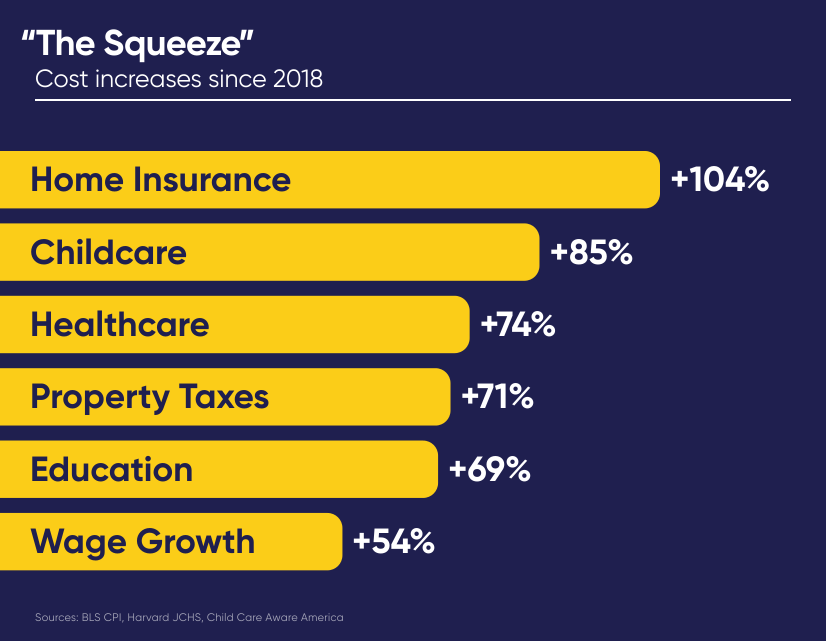
- Property taxes have risen sharply in nearly every major market as home values and municipal budgets have soared.
- Homeowners’ insurance premiums have spiked dramatically — and in many states, coverage is becoming harder to obtain at any price.
- The cost of home maintenance and repair has surged with labor and materials inflation.
And beyond the home itself:
- Healthcare costs for the average American family have more than doubled in the last 15 years.
- The cost of a four-year college education has increased nearly three times the rate of general inflation over the same period.
- Childcare costs in most major metros now equal or exceed a mortgage payment.
Meanwhile, wages for the median American household have grown at roughly half the rate of home values. We don’t just have an affordability crisis that makes it hard to buy a home. We have an affordability crisis that makes it hard to live life. Some homeowners are cash-constrained — not because they failed, but because the math of modern American life has moved against them.
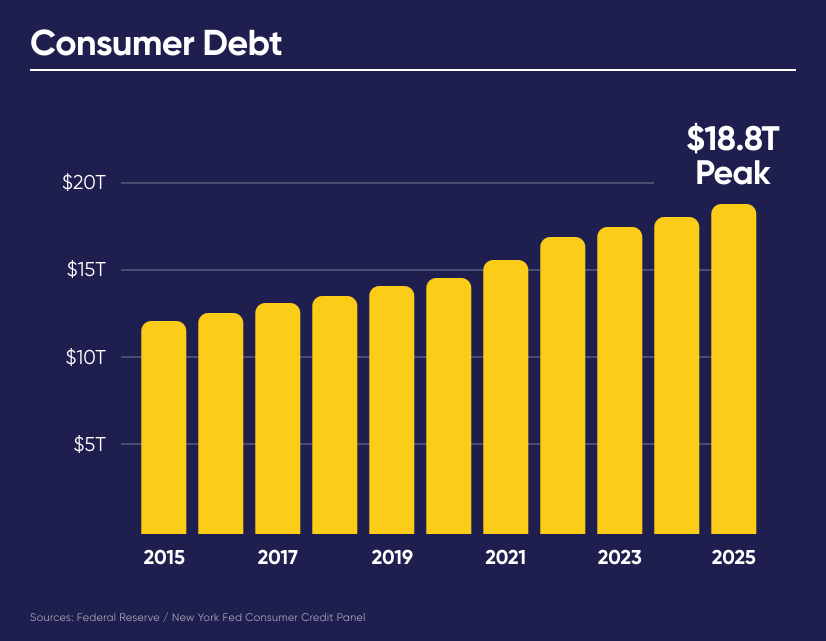
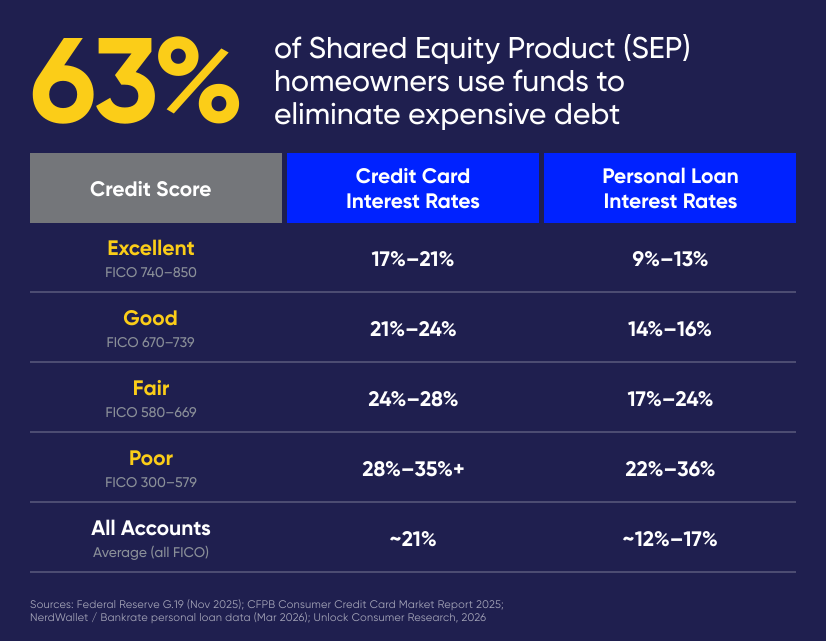
Consumer debt, which stands at an all-time high of $19 trillion, according to the Federal Reserve, reflects this reality. Credit card balances are at record levels, with average rates above 21%, report the New York Fed Consumer Credit Panel. Americans are not running up credit card debt because they are irresponsible. Many are doing it because it is the most accessible tool available when income doesn’t stretch far enough.
House Rich, Cash Poor
Let’s revisit Maddie, the homeowner struggling with a growing list of increasing expenses. She bought her home in 2012 for $280,000. It’s worth $640,000 today. On paper, she is wealthy. She has builtnearly $400,000 in equity over 13 years. And she is not alone.
American homeowners collectively hold over $35 trillion in home equity — and $11 trillion of that equity is tappable – the highest amounts ever recorded, according to the ICE Mortgage Monitor. Those numbers represent decades of mortgage payments, market appreciation, and financial discipline. So why not tap into some home equity to solve some of these problems?
As it turns out, the traditional tools available to access home equity have rarely been less attractive or more poorly suited to where homeowners actually stand today.
Lock-in Effect
More than 60% of American homeowners have a mortgage rate below 4%. The average rate on a new 30-year mortgage today is about 6.5%. For most homeowners, a cash-out refi would destroy that low-interest-rate mortgage payment – the one large monthly expense that will not increase during the life of the loan. So, they don’t refinance that loan. This interest rate lock-in effect is real, and it ismassive.
Some homeowners can access home equity with a HELOC, but HELOC rates are higher than mortgage rates and higher than they were five years ago, when they hovered around 4%, according to Experian. The qualification process can also be onerous, requiring proof of income and good credit. Even a reverse mortgage, which doesn’t impact a homeowner’s mortgage rate and doesn’t carry monthly payments, is restricted to those who are 62 and older.
So, for many homeowners, their home equity stays locked up, and they stay cash constrained.
Expanding Access
Shared equity products (SEPs) were designed to increase access to home equity by providing homeowners with more flexibility. A team of finance professionals conceived the product about 20 years ago, after realizing that homeowners could benefit from the ability to tap into their home equity without the requirement to make monthly payments. Their theory that homeowners were hungry for another method proved correct. Today, the industry is offering shared equity products in 39 states combined. Those SEP providers have served more than 80,000 homeowners and are expected to originate $5 billion in home equity agreements/home equity investments this year.
Investor interest has grown dramatically, providing the industry with the capital we need to continue funding shared equity products. Twelve rated securitizations totaling over $2 billion were issued in 2025, and we’ve had 1 more so far in 2026, all rated by DBRS Morningstar. Large banks, including Barclays and Deutsche Bank, have jumped in as warehouse lenders and institutional investors are entering the space in growing numbers.
Transparency: The Key to Growth
It is incumbent on Unlock and other industry leaders to ensure that homeowners understand how shared equity products work and what sets them apart from the traditional options for tapping home equity. Shared equity products exist not because homeowners have no options — but because they deserve better ones.
Traditional mortgage loans are a form of debt financing. When you access your home equity through a cash-out refinance, you are replacing your mortgage with a new, larger mortgage and take the difference between the two in cash. You are borrowing more money than you did when you took out your original mortgage based on the equity you’ve built in your home. A home equity loan works similarly. You borrow money, using your home equity as collateral. A HELOC uses the same premise, but instead of receiving a lump sum payment, you get access to a revolving line of credit. These methods of accessing home equity have principal balances, interest rates, amortization schedules, and monthly payments. They are underwritten primarily based on the homeowner’s credit score, income and debt load.
In contrast, shared equity products are a form of equity financing. A homeowner receives a lump sum payment in exchange for a share of the value of their home when the agreement ends. There are no monthly payments, just a single payment at the end of the agreement. There is also no principal balance, no interest rate and no amortization. Our products are based on starting and ending home values, investment amounts, multipliers, risk adjustments and protection caps. Traditional mortgage loan requirements are focused on income and credit scores. We focus on the home’s condition and the amount of equity a homeowner has.
Giving Homeowners Control
With shared equity products, flexibility and control are the name of the game, largely because they offer freedom from monthly payments. Payoff options are also versatile. Unlock homeownerstypically exit their agreement when they sell their home and share a percentage of the sales price. Homeowners can also buyout Unlock at any time or when the term ends. Unlock’s term is 10 years, but SEP providers offer terms ranging from 10 to 30 years. For those who choose to buy out their agreement rather than sell their property, the percentage share Unlock receives is based on the home’s appraised value.
Unlock also caps its return to prevent disproportionately high payouts in scenarios like rapid home appreciation or short-term agreements.
The Cost Equation
Like any home finance product, a shared equity product comes with upfront costs. Those can include origination fees for things like an appraisal, title report, and credit check. These are typically all deducted from your proceeds at closing.
How much you can access through a shared equity product can vary based on the provider. At Unlock, we consider a variety of factors including:
- Home value
- Available equity: Homeowners need to have at least 30% to qualify
- Credit score: Starting minimum is 500, with no recent mortgage lates or bankruptcies
- Existing debt: This includes all liens and debts secured by the property
- Property type: single-family, townhome, primary residence, investment property, etc.
The maximum amount available with Unlock is $500,000 and the minimum is $15,000. The Combined Loan-to-Value (CLTV)- which is the total percentage of your home’s value that’s financed across all liens — including your existing mortgage(s) and Unlock’s agreement – can range between 75% and 80% depending on your credit score. The CLTV cap limits how much total debt and investment can be secured by your property.
A homeowner’s payoff is largely impacted by home appreciation. If your home value grows, SEP providers will share in that growth. If it doesn’t grow as much, then the provider’s share will be less. The way the payoff is calculated differs depending on the provider.
Most companies use a Total Value model. In this model, the ending payment consists of a percentage share of the home’s value at that time. A multiplier determines the share percentage.
For example:
- Let’s say a homeowner has a property worth $500,000 and decides to pull out $50,000 in home equity through an Unlock home equity agreement.
- That means their cash from Unlock represents 10% of their home value at that time they start the agreement.
- To calculate the percentage that Unlock would receive at the end of the agreement, we take the 10% the homeowner received and multiply it by our pricing factor. In this case, we’ll use a pricing factor of 1.8
10 x 1.8 = 18%
- If the home appreciates by 2% during the 10-year term, the ending home value would be $609,497. So, Unlock would receive 18% of $609,497 or $109,709.
As noted earlier, Unlock caps its return in cases of significant home appreciation or short-term agreements to prevent excess payouts.
Shared Equity Products Versus Traditional Options
So, how do SEPs stack up against more traditional methods of accessing home equity? Let’s compare shared equity products with a HELOC – the most common way to access home equity. Current interest rates for HELOCs range from about 7% to 13%, depending on credit score and combined loan-to-value ratio. How does this stack up against shared equity? When you compare the interest rate on a HELOC to the annualized cost of the shared equity product, we are sometimes more expensive, sometimes less expensive.
But this comparison completely ignores two of our product’s core benefits. First: homeowners receive very significant value from the fact that shared equity products require no monthly payments while mortgage loan products, including HELOCs, do. That additional value cannot be captured in a numerical comparison, but it is very meaningful.
Second: for many homeowners, the HELOC cost comparison is irrelevant, because they can’t qualify for a HELOC. As the Urban Institute pointed out in its research, about 35% of equity extraction mortgage loans were declined in 2024. Shared equity products are generally more widely available.
Now, for the 63 percent of our customers who use SEP proceeds to pay down expensive debt, perhaps the more relevant comparison is the cost of the debt they’re eliminating. If a homeowner eliminates credit card balances at 24%, a shared equity product is not more expensive; it is significantly less expensive.
Shared equity products have a real cost. But there is no monthly payment obligation, no impact on the homeowner’s existing mortgage rate, and a cost that is only realized when the homeowner is ready to end the agreement — typically when they sell or refinance on their own timeline. They can also wait to settle when the agreement ends. For some, the product is easier to qualify for. For the right homeowner, in the right situation, the shared equity product is not expensive. It can be the most rational financial decision.
Think about Maddie – our single homeowner with $400,000 in equity and a low mortgage rate she can’t afford to give up. She has looked at her options carefully — because she’s smart, she’s informed, and she understands her own financial situation better than anyone. Not because it was her only option. Because it was her best option.